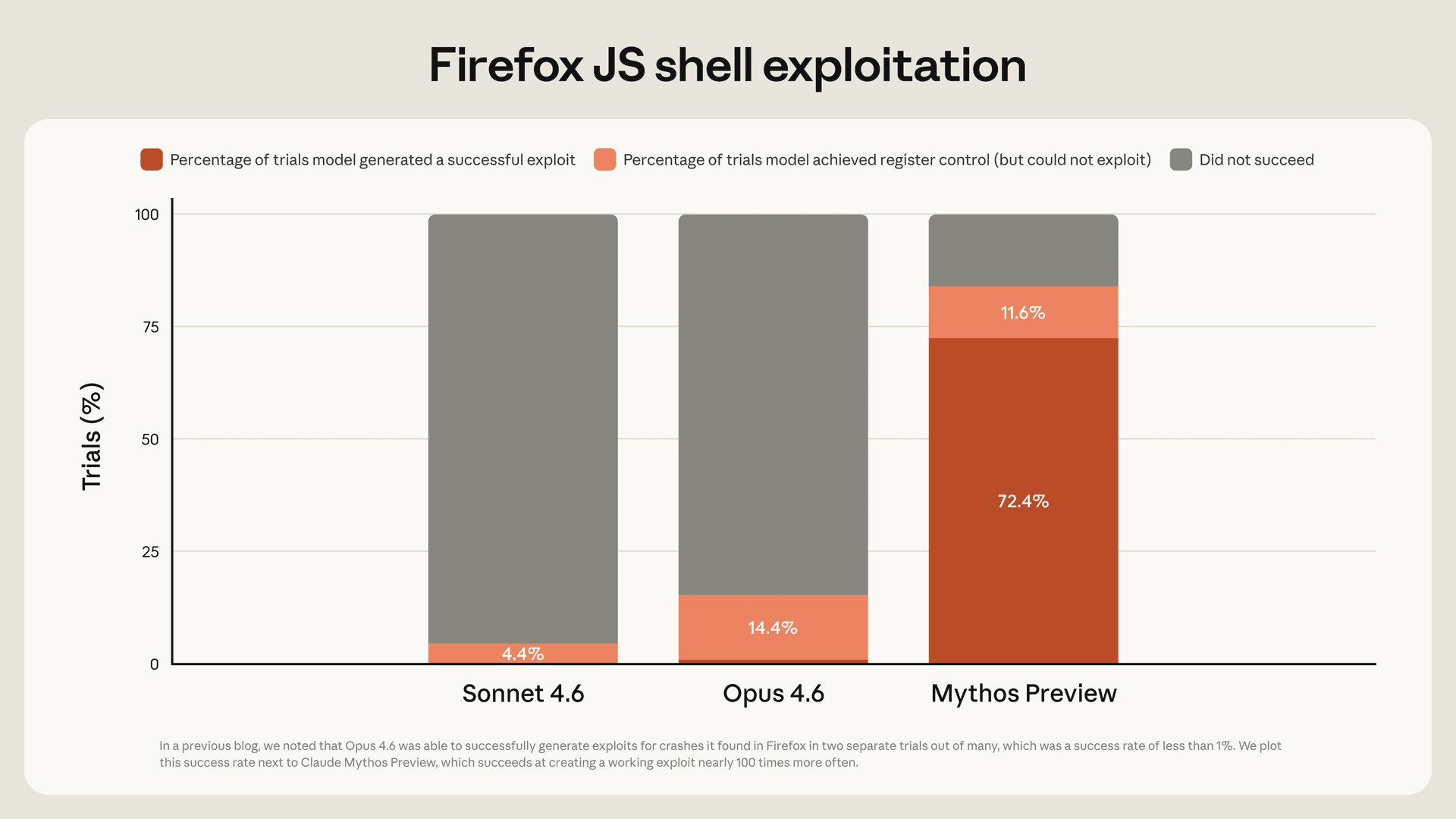
 Source: Anthropic
Most AI announcements follow a familiar pattern — better benchmarks, faster responses, more capabilities.
Claude Mythos feels different.
Not because it’s incrementally better.
But because it forces a more uncomfortable question:
What happens when AI becomes really good at finding — and exploiting — vulnerabilities?
The Shift: From Code Generation to System Exploitation
For the past couple of years, AI has mostly helped developers:
- write code faster
- generate boilerplate
- assist in debugging
Claude Mythos signals a shift beyond that, it demonstrates the ability to:
- analyze large codebases
- identify subtle vulnerabilities
- reason about how those vulnerabilities can be exploited
This isn’t just assistance, it’s closer to automated adversarial reasoning.
Why This Matters More Than It Seems
Cybersecurity has always been asymmetric.
Defenders need to secure everything.
Attackers only need one mistake.
AI changes the scale of that asymmetry.
What previously required:
- deep expertise
- significant time
- manual effort
can now be accelerated dramatically.
The real concern isn’t that AI can find bugs. It’s that it can connect them.
The Problem Isn’t Discovery — It’s Reliability
Finding vulnerabilities is one thing, turning them into something actionable is another.
What makes systems like Mythos notable is not just detection, but:
- consistency in reasoning
- ability to follow multi-step logic
- understanding of real-world system behavior
That combination starts to look less like a tool
and more like a capability multiplier.
So Why Isn’t Mythos Public?
This is where things get interesting.
Anthropic’s decision to limit access isn’t just caution — it’s a signal.
Releasing a model like this broadly would mean:
- vulnerability discovery at scale
- faster zero-day identification
- reduced barrier for sophisticated attacks
In other words:
The same capability that helps secure systems can also destabilize them.
There’s currently no mature ecosystem that can safely absorb that level of power.
So instead of a public release, Mythos is being tested in controlled environments — working with select partners to identify and fix vulnerabilities before wider exposure.
What This Means for Developers
It’s tempting to see this as a “security team problem.”
It’s not.
The implications are much closer to everyday development.
1. Assumptions Are Becoming Fragile
The idea that:
“this edge case is unlikely”
or
“this logic won’t be explored deeply”
is becoming less reliable.
AI can explore systems in ways humans don’t.
2. Security Is No Longer a Phase
It can’t sit at the end of the pipeline anymore.
It has to be:
- part of design
- part of implementation
- part of iteration
Because vulnerabilities won’t stay hidden for long.
3. “Works” Is Not Enough
With AI accelerating development:
- more code gets written
- more systems get built
- more surface area gets exposed
Which means:
The cost of “almost correct” systems increases.
The Bigger Picture
Claude Mythos is not just about one model, it represents a broader trend:
AI systems are getting better at:
- reasoning
- exploring complexity
- identifying weaknesses
And those capabilities apply just as well to breaking systems as they do to building them.
Final Thought
For a long time, software development has been about building things that work.
We’re moving into a phase where we also need to build things that can withstand
systems that are exceptionally good at finding what doesn’t.
Claude Mythos is an early glimpse of that world.
And the fact that it isn’t public yet
might be the most important signal of all.